The Curry Brief

The Curry Brief: Thoughts on the upcoming Western Conference Finals between Oklahoma City Thunder and Golden State Warriors.

Thoughts on the NBA’s Western Conference Finals

Back on February 27th, the Oklahoma City Thunder and the Golden State Warriors played in what was probably the best game of this year’s NBA season. Five Western Conference All Stars competed. OKC’s Kevin Durant and Russell Westbrook scored 37 and 26 while Golden State’s Steph Curry and Klay Thompson went for 46 and 32. The fifth all star, the Warriors’ Draymond Green, had fourteen rebounds, fourteen assists, six steals, and four blocked shots. Although the Warriors trailed by seven points with less than five minutes to go and by four with fourteen seconds left in regulation, they still managed to win in overtime on a long Curry three-point shot he stroked from beyond thirty feet with less than a second remaining.

I recently took a look back at the game and came up with a few ideas for slowing down the two-time reigning MVP.

1.  Crowd Curry When He Has The Ball

giphy

Just about everyone gives Curry space believing that this will help contain his drive. If Curry has any room at all, he will unleash his pregame warm up on the defender in varying combinations. Against Singler, Curry goes between his legs into a crossover dribble, between the legs again, crosses over, and then crosses over one last time before stepping back for what seems like an impossible shot. While Curry will hurt teams with his drives, at least he won’t make twelve threes. 

2. Make Curry Pick Up The Dag Gum Ball

Every chance Curry gets, he’ll let the ball roll up the court without touching it. This allows for the Warriors to maximize all of the time on the shot clock. During the OKC / Warriors game back in February, there were several times Curry didn’t pick up the ball until it was near mid court.

3. Attack Curry on Defense Whenever You Can

i4j4ypszgw0es

Sure, it’s old news to make the star offensive player work on defense, but OKC needs to do this even more. It’s not just attacking him 1 on 1 as Westbrook does above, but I’d try and put him in as many screen situations as possible. Who Curry guards should be screening for the ball or a shooter on a downscreen. During the regular season match up, Curry spent too many defensive possessions standing in the corner doing nothing.

4. When You Attack Curry, Be Prepared for Lots of Help

You’ve got to do more than isolate Curry; you have to plan for where the help is going to come from. The Warriors usually defend isolation plays by putting every single player in the lane and this often causes Westbrook or Durant to call off the attack, kick the ball to a low percentage shooter, or attack too deeply into a double team that often brings Warriors center Andrew Bogut, once an all NBA defensive team selection. Recently, instead of putting their big men in the corner, OKC has been filling both blocks for offensive rebounds and lob dunks.

5. Don’t Switch

suwvaormkplo

Double team Curry on high ball screens if you have to, otherwise you’re going to see a lot of what is pictured above.

Of late, OKC has had a lot more ball movement on offense and made use of their players NOT Durant and Westbrook. I’m looking forward to seeing how OKC tries to defend Curry when he has the ball and the ways they try to make him work on defense. It should be a great series!


Welcome to Torg Stories!

Torg Stories books, films, basketball player development, and podcasts.

Torg Stories is a place for me to write about what tugs at my attention. I spend a lot of my time thinking about writing and the teaching of writing, content creation, and coaching basketball. Over the years, I’ve directed four films, had three books of fiction published, and won several screenplay awards. I’ve organized some of the topics I write about into the following categories:

  1. Youth Basketball Workouts and Player Development
  2. My family’s French Broad River Adventure
  3. The Craft of Writing and Teaching Writing

Like Holden Caulfield says in The Catcher in the Rye, “The trouble with me is, I like it when somebody digresses. It’s more interesting and all.” Rather than chastise myself about too many digressions or what could be seen as a scatterbrained approach to my work, I’ll say my writing here embraces an interdisciplinary way of thinking that allows for more of life to come in from the outside and get onto the screen. A big hope for this space is that it might allow us to learn from each other and share a good story or two. Like this one time, me and my family–having never rafted on our own in our entire lives–rafted 149 miles of the French Broad River…

On the French Broad River Torgerson French Broad River Paddle Trail Asheville Rosman MountainTrue RiverLink
Charlotte, Bill, Izzy and Megan Torgerson with Hot Springs, NC in the Background

A bit more about me: I’m a native Midwesterner who was born in Logansport, Indiana and a person who moved to Illinois to go to college, back to Indiana to teach and coach, to North Carolina for graduate school, to Georgia for more graduate school, to New York City to teach at St. John’s University, to Connecticut to escape the crowds, back to New York City to escape the commute, back to North Carolina for the mountains, back to Indiana to coach, and now we Torgs are getting ready for another move back to North Carolina. Next fall I will begin a lecturer position teaching composition at Appalachian State University in Boone. A few things I learned the past year:

  1. I found it impossible to meet my expectations for the kind of English teacher, basketball coach, husband, and dad I wanted to be balancing all of those responsibilities.
  2. I want to be free in the late afternoons to spend time with my wife and daughters, whether it’s playing hoops, working out, doing homework, creating content, or going on family adventures.
  3. We Torgs feel at home in the mountains of North Carolina.

Below, you’ll see a bit of what I’ve been up to over the years:

Books

Click here for Torg books for sale on Amazon

Indiana, basketball, love, divorce, winamac, Indiana, Pat Conroy, book club

Pat Conroy called The Coach’s Wife, “One of the best books about basketball and coaching I have ever read with a love story so complicated and wonderful it will have book groups talking about it for years.”

Thanks to Pat. I learned a lot about writing from reading his work, and I’m thankful to be able to keep hearing from him via his books.

***

MIdwestern Gothic, novel in stories, Winamac, Indiana, basketball, Flannery O'Connor, William Torgerson

Horseshoe is Midwestern Gothic collection of stories with themes about love, sin, guilt, and redemption.

romantic comedy, eighties, John Hughes, Say Anything, Olivet Nazarene University, basketball, college writing, winamac, Indiana, book club

In Love on the Big Screen, Zuke is a college freshman whose understanding of love has been shaped by late-80’s romantic comedies.

Films

morel mushrooms, hunting, Indiana, France Park, Bill William Torgerson, Martin Torgerson

The Mushroom Hunter is about my father and his buddies’ passion for hunting morel mushrooms.

Click here to watch “The Mushroom Hunter” free online.

More Torg Stories films: Christopher’s Garden and For the Love of Books

Crazy in the Night: March 24th, 2015 Podcast

A reader of The Coach’s Wife asks about the “truth” of the stories in the novel about coaches and parents. So there’s talk of the writing process, how fiction works for me, and how I fight off losing my mind when I wake up with too many thoughts at night.


Torg’s New Novel: The Coach’s Wife

“In his novel The Coach’s Wife, William Torgerson has written one of the best books about basketball and coaching I’ve ever read. He’s also written a love story so complicated and wonderful it will have book clubs talking about it for many years.”

–Pat Conroy, author of The Prince of Tides and The Death of the Great Santini

Indiana, North Carolina, basketball, novel, coaching, coach's wife, Pat Conroy, My Losing Season

Amazon, Barnes and Noble

First Chapter PDF, Torg Reads an Excerpt

In The Coach’s Wife, I draw on my experiences coaching high school basketball in Indiana and the end of several romantic relationships. The story is set in a fictionalized version of my hometown of Winamac, Indiana. Although the story stands on its own, it can also be read as a sequel to Love on the Big Screen.

Here are some endorsements written by writers I admire who were generous enough to take their time to read the manuscript:

  • “Torgerson has crafted an engaging and realistic portrait of Coach Eric Zaucha. The Coach’s Wife reveals one man’s quest for success on the Indiana basketball court, and for love, with admirable detail and insight.” -Allen Gee, author of My Chinese America 
  • “Meet Zuke, basketball coach, romantic, and narrator of this haunting, fast-paced novel, a tale of love and loss and acceptance, and all that we must learn when the party of college is over.” Peter Golden, author of Comeback Love
  • “You couldn’t ask for a more irresistible premise and Torgerson stirs it up with a backdrop including O.J. Simpson, Kurt Cobain, and Lady Di. A treacherous and hilarious journey through the human heart that beats with hope on every page.” –Caroline Leavitt 

If you’ve read the book, love to hear from you in the comment section. If you have friends who might be interested in the book, I’d appreciate it if you would pass along this link to them. Thank you for taking the time to read this page and keeping the conversation surrounding books alive!

What are you working on? Discussion in the Writing Classroom

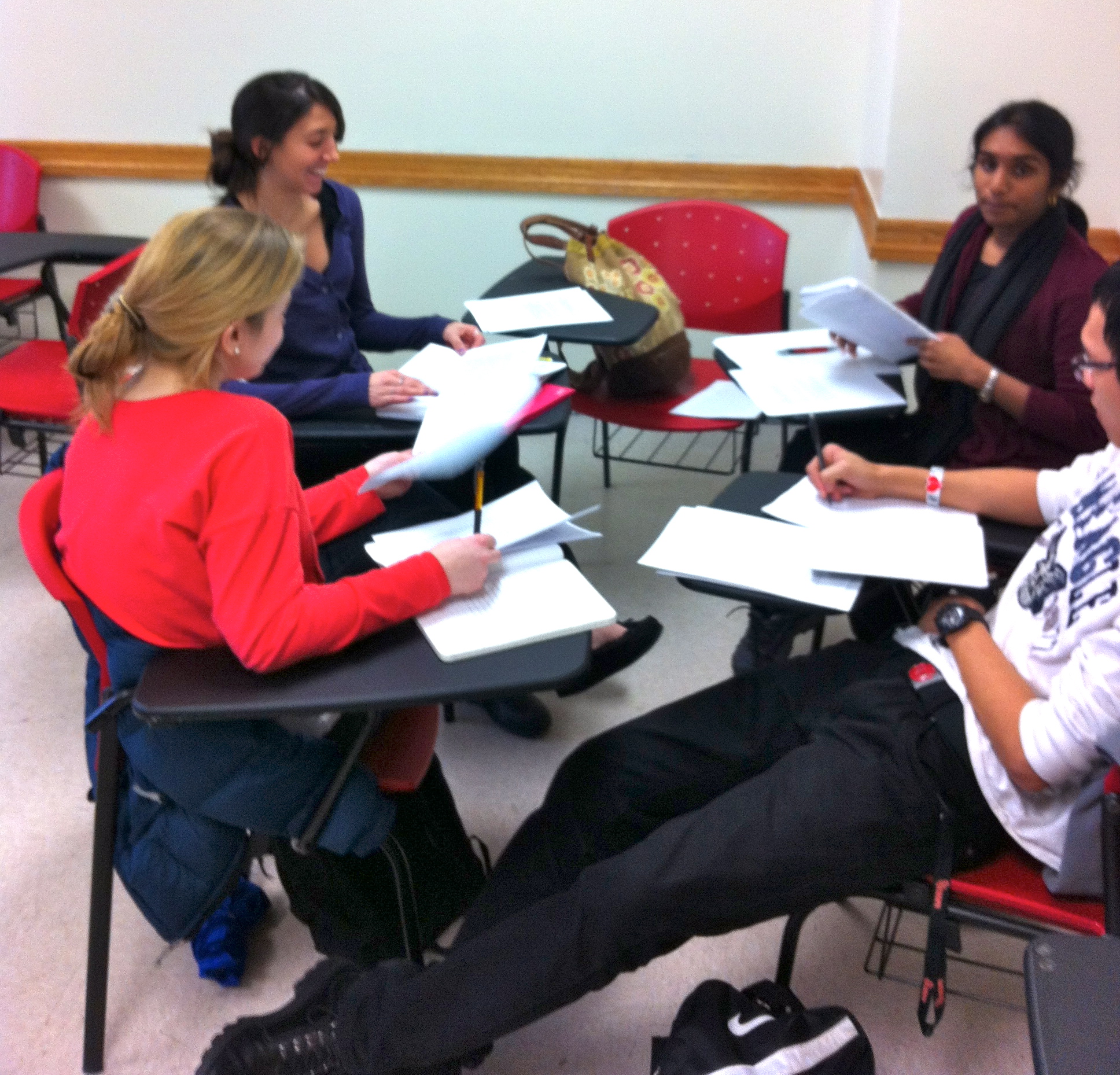
In the writing classrooms where I teach, we often sit in a circle and do a “quick share” to begin class where everyone offers a brief comment. Examples of what students might say include a golden line from a reading, a question for our fellow writers, or an observation about a project in progress they are working on. Beginning in this way helps me to avoid talking too much to start off the class, and I hope to encourage students who might otherwise just sit back and relax to try and engage actively with the activity of the course.

William Torgerson teaching writing research composition discussion college

the challenge of conversation


Even trying for rapid-fire sharing around the room, with up to twenty-five students, writers can get bored, feel left out, or be uncomfortable enough talking in front of a group that they don’t speak in a way that the students in the class can hear them.  Even if a student speaks two minutes out of fifty, that’s not much engagement or opportunity to be heard. In considering this problem, I’m taken back to my days as a basketball coach. I was always looking for ways to maximize our practice time and the opportunities each player had to improve. For example, if I were to put fifteen players in a line and have them shoot, get their own rebound, and then pass to the next player, then each player might get three shots in ten minutes.  This isn’t helping anyone very much and to my way of thinking, not so different than a student in a writing class who only gets to be heard once or twice. So what to do?

As a teacher, I often go back to my time as an athlete and then a coach. For me, developing as a writer has a lot in common with my development as a shooter of the basketball or training for a long run.  When I coached and wanted to get my players more practice, I arranged shooters into five lines of three, and all of the sudden each player got five times the amount of practice than if they were in one big-long line. The classroom version of this basketball solution would be to make use of small groups. Theoretically, a student in a small group has more opportunity to join a conversation about their reading and writing. However, I’ve been in small groups as a student and now as a faculty member, and I’m often not impressed with the sort of work that gets done. There’s often a lot of noise, but it doesn’t often seem to be the noise of conversation about reading and writing. If you want students (or faculty) to work in small groups, then there has to be a plan for how this conversation can flourish.  As someone who was beginning to get more and more interested in Twitter, I wondered about the possibility of using it to enhance classroom conversation.  More on that experiment in coming posts, and if you’ve got your own ideas about classroom discussion or the use of small groups, I’d love to hear them!